





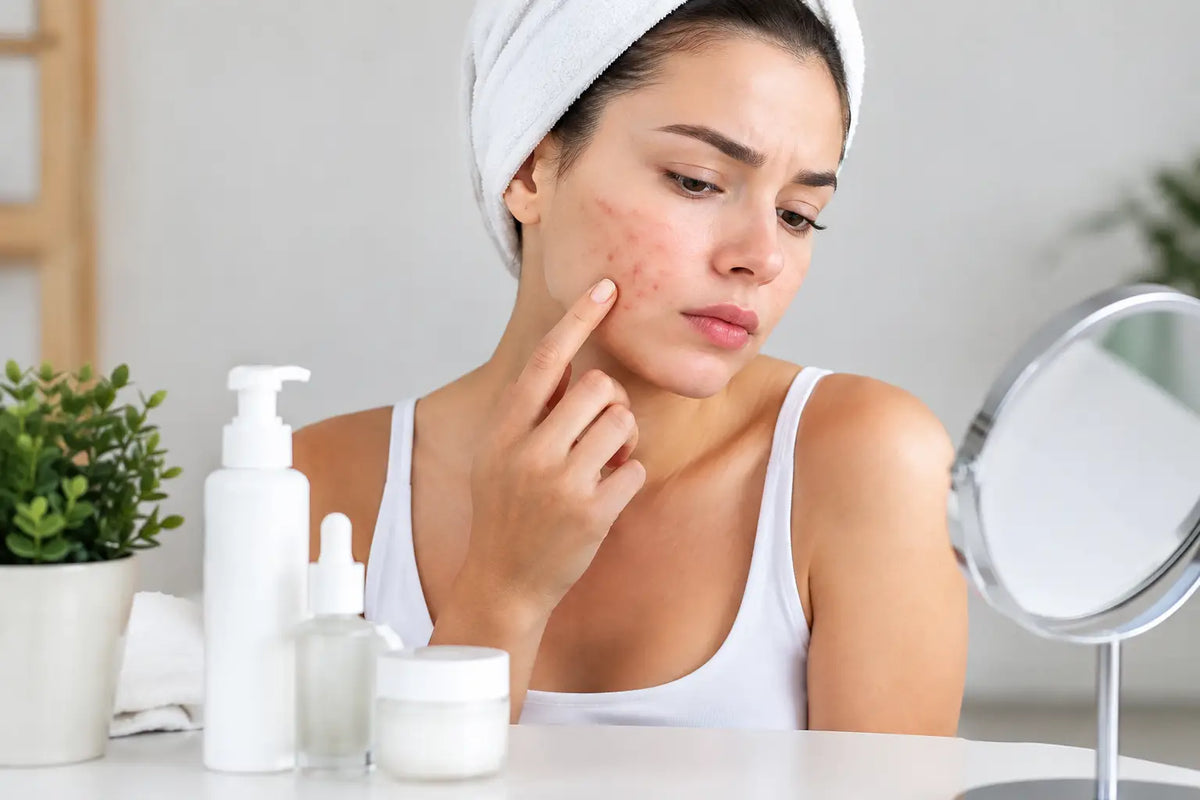
Yes, acne products can cause irritation, especially when several exfoliating or drying products are used at once or a new formula is used too often. If you have a drawer full of half-used bottles, you may know the pattern: your skin feels worse, you cannot tell which product caused it, and quitting everything starts to sound sensible.
Irritation does not mean you caused your acne or failed at skincare. Adult acne is frustrating enough without fine lines, uneven-looking texture, and products that seem to demand a chemistry degree. The useful question is not whether you can tolerate the most intense routine. It is whether your routine is doing what you need without leaving your skin sore, tight, or reactive.
Why can acne products cause irritation?
Acne treatments work by changing what is happening inside a clogged pore or on the skin’s surface. That can be helpful, but the same process can also disrupt the outermost layer of skin when the formula, frequency, or combination is too much for you.
Salicylic acid is an FDA-recognized over-the-counter acne treatment ingredient used for acne at concentrations from 0.5% to 2%. It helps clear clogged pores by loosening the material that can collect inside them. Retinol is commonly used for smoother-looking skin and more even-looking texture. Both can be useful in a routine, but either can bring dryness, stinging, or visible peeling when introduced too quickly.
The American Academy of Dermatology notes that acne medicines can cause dryness and irritation. That is not a small footnote. Skin that is continually inflamed can look redder, feel rougher, and make every next product harder to judge.
Your reaction may come from the acne treatment itself, the rest of the formula, or the way products are layered. A medicated cleanser followed by an exfoliating toner and a leave-on treatment may sound thorough. For many people, it is simply too much exposure in one routine.
Is it irritation, a breakout, or an allergy?
They can look similar in a bathroom mirror, but they call for different responses.
Irritation often feels like burning, stinging, itching, tightness, or tenderness. You may see dry patches, flaking, or diffuse redness in places where you do not usually break out, such as around the mouth or beside the nose. It can appear soon after application, though repeated use can gradually bring it on.
A breakout is more likely to show up in your usual acne-prone areas as individual clogged pores, blackheads, whiteheads, or inflamed pimples. Starting a product that changes surface-cell shedding can sometimes coincide with more visible congestion before the routine settles. But a worsening rash, persistent burning, or breakouts spreading into unfamiliar areas should not be brushed off as “purging.” That label is often used too casually.
An allergic reaction can include marked itching, swelling, hives, or a rash that spreads beyond where the product was applied. Stop using the suspected product and seek medical care promptly, especially for facial swelling, trouble breathing, or widespread hives.
Can you use salicylic acid and retinol together?
Yes, some people can use salicylic acid and retinol in the same overall routine. It depends on the formulas, how often they are used, and what else is already on your skin.
The trade-off is straightforward. Combining them may simplify a routine for someone managing clogged pores and signs of skin aging, but it also raises the chance of dryness or stinging if the skin is already irritated. More treatment is not automatically better treatment.
Start with the product directions, not an aggressive schedule copied from someone else. Keep the surrounding routine plain: a gentle cleanser, a moisturizer you know you tolerate, and daytime sun protection. Introducing several new products at once makes it nearly impossible to know what your skin is reacting to.
Encapsulation can change how an ingredient is formulated, but it does not make irritation impossible. The goal is not to chase a tingle. A product does not need to sting to be working.
What should you do if acne treatment burns or peels?
If a product causes clear burning or ongoing discomfort, stop using it for now. Use a mild cleanser and a simple moisturizer until the skin no longer feels raw or tight. Avoid scrubs, exfoliating pads, fragranced treatments, and any other product that makes the sensation worse.
Once your skin feels calm again, reintroduce only one treatment according to its label directions. This is less exciting than replacing your whole shelf, but it gives you useful information. If irritation returns with the same product, it may not be the right formula or frequency for you.
Do not try to “push through” significant irritation in the hope that your skin will adjust. The FDA’s over-the-counter acne guidance includes warnings about dryness and irritation because these reactions are known possibilities. Persistent discomfort is a reason to reassess, not a test of commitment.
| What you notice | A practical next step |
| --- | --- |
| Mild dryness or brief tightness | Simplify the rest of the routine and follow product directions carefully. |
| Burning, visible peeling, or lasting redness | Pause the suspected treatment and use gentle basics until comfortable. |
| Swelling, hives, or a spreading rash | Stop using the product and seek prompt medical care. |
Why does adult acne make irritation harder to manage?
Adult acne rarely arrives alone. You may be managing a chin breakout while also noticing fine lines, post-acne marks, or makeup catching on dry patches. The common advice to dry out every blemish can feel especially wrong when your skin already looks and feels depleted.
This is why a shorter routine can be a relief. It is not about doing less because you have given up. It is about reducing the number of variables competing for space on your face. One well-chosen acne treatment, paired with basic supportive products, is often easier to use consistently than a rotating collection of acids, masks, spot treatments, and serums.
Peer-reviewed dermatology literature, including work published in the Journal of the American Academy of Dermatology, has long described irritation as a common limitation of topical acne therapy. The implication is practical: tolerability matters. A routine you can use as directed is more useful than a complicated one that repeatedly leaves your skin angry.
When should you see a dermatologist for acne irritation?
See a dermatologist if irritation does not settle after you stop the suspected product, if acne is painful or deep, or if breakouts are leaving persistent marks. A dermatologist can also help when acne begins suddenly, changes sharply, or does not respond to over-the-counter care.
For a parent helping a teenager, keep the same approach calm and simple. Do not add multiple treatments because one product has not changed things immediately. If your child has painful breakouts, significant distress, or a rash after using acne treatment, contact a clinician. Ask a doctor before using acne products for children, or during pregnancy or breastfeeding.
Can a simpler acne routine prevent irritation?
Often, yes. A simple routine does not guarantee that every formula will agree with your skin, but it lowers the chance that several irritating steps will overlap. It also makes the source of a reaction easier to find.
For readers who want a single twice-daily step rather than a shelf of separate treatments, XVesuvius® is an FDA over-the-counter acne drug formulated with 2% salicylic acid, plus encapsulated retinol, peptides, honey, ferments, and botanical extracts. It is one option to consider if you want acne care alongside skin that looks smoother and more even. Use it only as directed, and let comfort be part of the decision.
The next step is not to buy more products. It is to give your skin a quieter routine, notice what changes, and get medical guidance when the reaction is more than mild.


Share:
Understanding FDA OTC Acne Drug Facts Clearly
Acne Ingredient Guide for Adult Breakouts