





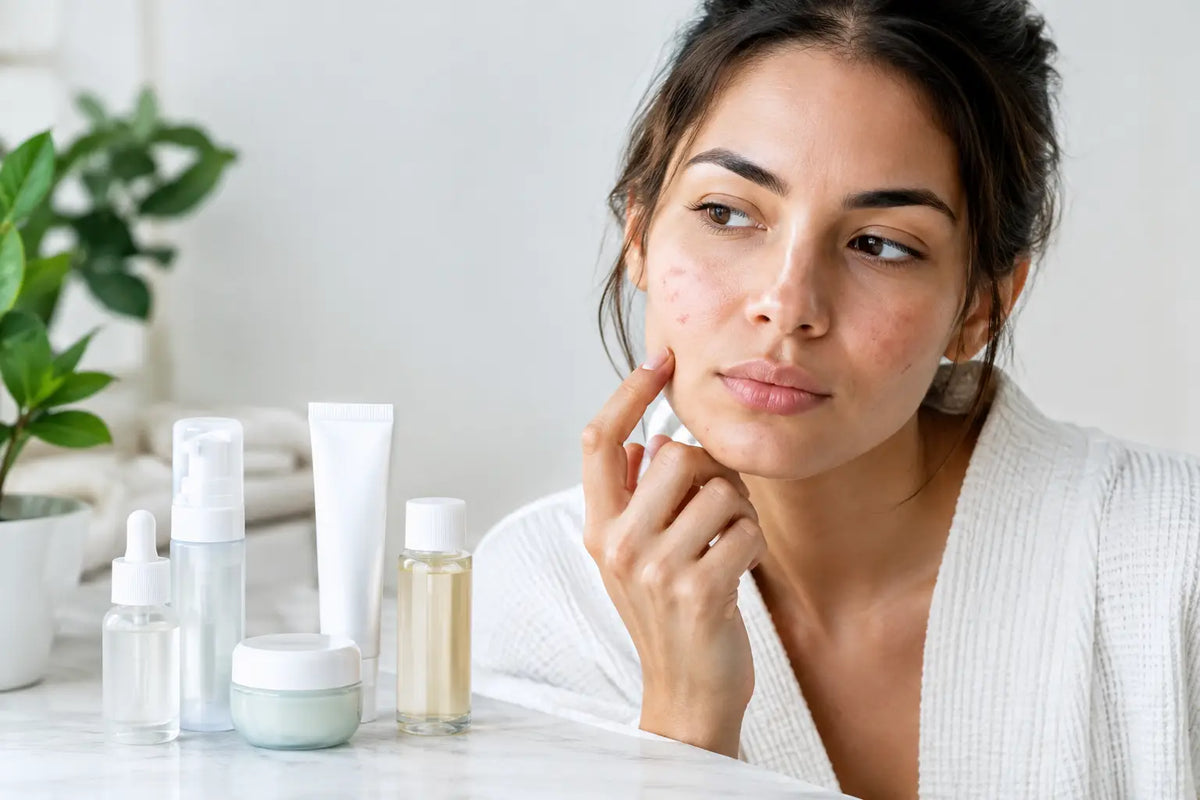
The useful version of an acne ingredient guide is simple: choose an ingredient based on the kind of breakout you have, not the loudest claim on the bottle. If you have a drawer of half-used treatments, you already know how quickly a routine can become a pile of products that irritate your skin without answering the actual problem.
Adult acne can look different from the acne you had as a teen. It may show up as clogged pores across the forehead, blackheads around the nose, or recurring breakouts along the chin and jaw. Fine lines and uneven-looking texture may be part of the picture too, which makes the usual advice to dry everything out feel especially unhelpful.
Acne is not a hygiene failure. You did not cause it by missing a cleanse, wearing makeup, or lacking discipline. Acne begins inside the pore, where oil, dead skin cells, and inflammation can create the conditions for a visible breakout. The ingredient that makes sense depends on which part of that process is most noticeable for you.
Which acne ingredients help clogged pores and blackheads?
Salicylic acid is often the most direct place to start for blackheads, whiteheads, and pores that feel congested. It is oil-soluble, meaning it can work within the oily environment of the pore. In an FDA over-the-counter acne drug, salicylic acid is recognized for treating acne. The FDA monograph permits salicylic acid in a range of 0.5% to 2%.
For someone whose skin feels bumpy before it looks broken out, salicylic acid can be a practical fit. It helps loosen the buildup that contributes to clogged pores rather than simply making the surface feel tight. That distinction matters. Skin can feel stripped and still have clogged pores underneath.
Benzoyl peroxide is another established over-the-counter acne ingredient. It is commonly used for inflamed pimples, especially when breakouts are red and tender. The trade-off is that it can be drying, can irritate some skin, and may bleach towels, pillowcases, or clothing. It can be a good choice, but more is not automatically better.
Here is the short version of how common ingredients differ:
| Ingredient | Often a fit for | What to keep in mind |
| --- | --- | --- |
| Salicylic acid | Blackheads, whiteheads, clogged pores | Can feel drying if paired with too many exfoliating products |
| Benzoyl peroxide | Inflamed pimples | May cause dryness and can bleach fabrics |
| Retinol | Uneven-looking texture, fine lines, recurring congestion | Can be irritating if introduced alongside too many acne treatments |
| Azelaic acid | Visible redness and post-acne marks | Formulas vary, so the overall routine still matters |
No ingredient can promise perfect skin. An over-the-counter routine also has limits: persistent deep, painful bumps, widespread breakouts, or acne leaving lasting marks deserve a conversation with a dermatologist. Those concerns may need care beyond what a topical over-the-counter product can address.
Can you use retinol and salicylic acid together?
Yes, retinol and salicylic acid can be used in the same overall routine, but it depends on the formula, your skin’s tolerance, and everything else you are applying. The problem is rarely that either ingredient is inherently wrong. The problem is stacking a retinol serum, an exfoliating toner, a scrub, a spot treatment, and a harsh cleanser because each product sounds necessary.
Retinol is not an FDA over-the-counter acne drug ingredient. In skin care, it is used for the appearance of smoother texture, more even-looking skin, and softened fine lines. It may also be helpful for people who are tired of choosing between addressing breakouts and maintaining an anti-aging routine.
Using separate products can work, especially if you prefer to adjust each step independently. But it takes restraint. If your skin becomes persistently stinging, flaky, tight, or visibly irritated, adding more treatments is unlikely to solve it. Pulling back to a gentle cleanser, a plain moisturizer, and one acne-focused step can make it easier to tell what your skin actually tolerates.
A formula designed to include both salicylic acid and encapsulated retinol may be easier to manage than combining several strong products on your own. Encapsulation is a formulation approach, not a promise that irritation cannot happen. Read the label, follow its directions, and give your routine room to work before changing it again.
If you are pregnant or breastfeeding, ask your doctor before choosing a retinol product or acne treatment.
What should an adult acne routine include?
For many adults, the best routine is smaller than the one they have now. A gentle cleanser, a moisturizer that feels comfortable on your skin, sunscreen during the day, and one treatment step can be enough structure to start. More steps may be useful in some cases, but every extra product adds another opportunity for irritation or confusion.
If clogged pores are your main concern, an FDA-recognized salicylic acid treatment may make more sense than adding another scrub. If red pimples are your main concern, benzoyl peroxide may be worth considering, with attention to dryness. If your skin concerns include the appearance of fine lines and uneven texture, retinol may belong in the conversation too.
The American Academy of Dermatology includes topical retinoids, benzoyl peroxide, and salicylic acid among commonly used acne treatment options. That does not mean every person needs all of them. It means the ingredient list should serve a clear purpose.
A useful question is: what is this product doing that another step in my routine is not? If the answer is vague, you may not need it.
How do you avoid irritating acne-prone skin?
Start with the routine you can repeat without punishing your skin. Avoid changing several products at once, because you will not know what helped or what caused irritation. A gentle cleanser and moisturizer are not failures of ambition. They are what allow an acne treatment to be used consistently.
Watch for signs that the routine is becoming too much: ongoing burning, increasing redness, cracking, or a rash. Stop the product that seems to be causing the reaction and seek medical advice if symptoms are severe or do not settle. For a teenager, a parent can take the same calm approach. Over-the-counter acne care can be appropriate for many families, but deep painful acne, significant distress, or persistent irritation are reasonable reasons to contact a dermatologist.
Be skeptical of any routine that requires you to tolerate ongoing discomfort as proof it is working. Acne treatment may involve an adjustment period, but pain is not a requirement for progress.
What is the simplest option for acne and aging concerns?
The simplest option is the one that addresses your real concerns without turning the bathroom counter into a project. For adults with blackheads, clogged pores, breakouts, and early signs of skin aging, that may mean choosing a formula with an acne treatment ingredient and cosmetic ingredients aimed at smoother, more even-looking skin.
XVesuvius® is an FDA over-the-counter acne drug formulated with 2% salicylic acid, along with encapsulated retinol, peptides, honey, ferments, and botanical extracts. It is one option for people who want a single twice-daily step rather than a collection of separate treatments.
Choose the ingredient that matches what you see in the mirror, use it as directed, and let a simpler routine show you what it can do.


Share:
Can Acne Products Cause Irritation? What to Do
How to Reduce Routine Irritation Without Quitting Acne Care