





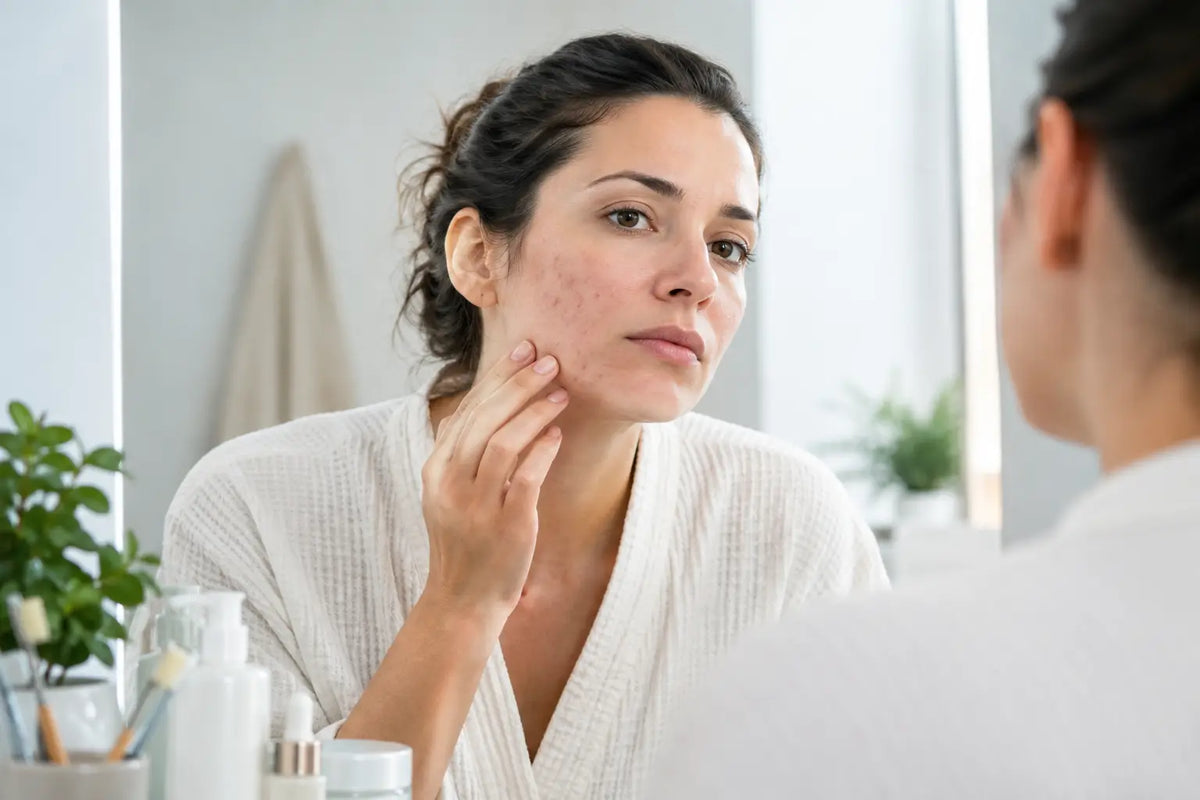
Why acne persists after thirty is usually not because you are doing skincare wrong. It is because adult skin can still clog and inflame while you are also trying to avoid the dry, tight feeling left by acne routines that were clearly made for a teenager.
The frustrating part is how often the old advice fails. You may have a drawer of half-used treatments, a carefully chosen moisturizer, and breakouts that still show up along the jawline or chin just as fine lines start asking for attention. That is not a lack of discipline. It is a signal to look at what is keeping the cycle going.
Why does acne persist after thirty?
Acne begins in the pore. Dead skin cells and oil can collect inside the follicle, forming a clogged pore. A blackhead is an open clog exposed to air. A whitehead is a closed clog. If the area becomes inflamed, it can become a pimple that is sore, red, and hard to ignore.
That basic process does not end on a birthday. For many adults, it is influenced by shifts in hormones, products that do not agree with their skin, and treatments that create so much dryness or irritation that the routine becomes impossible to keep using. Adult acne can also look different from the acne you had earlier in life. Instead of scattered forehead breakouts, it may concentrate around the chin, jawline, or lower face.
The American Academy of Dermatology recognizes that acne affects adults as well as teenagers. Research discussed in the Journal of Clinical and Aesthetic Dermatology also describes adult female acne as a distinct and common concern, often shaped by hormone-related patterns and the realities of adult skin care.
Hormones matter, but they are not the whole explanation. Changes around a menstrual cycle can affect oil production and inflammation. Some people notice breakouts with changes in medication or after stopping a hormonal medication. Persistent breakouts that are deep, painful, or tied to other body changes deserve a conversation with a dermatologist, who can help sort out whether acne is the only issue.
Can your acne routine be keeping breakouts going?
Sometimes, yes. This is not a blame statement. It is an ingredient and routine problem, not a character flaw.
A routine can become too aggressive when it stacks exfoliants, scrubs, drying toners, and frequent spot treatments. Skin may feel clean immediately, then sting, flake, or look more uneven. Irritation does not clear a clog. It can make acne harder to manage and make you abandon a routine before it has a fair chance to work.
On the other side, rich makeup, sunscreen, hair products, or skin care formulas can contribute to congestion for some people. You do not need to fear every cream. You do need to pay attention to patterns. If new bumps begin after introducing a product, pause it and simplify rather than adding several more treatments to compensate.
| What you notice | A useful response |
| --- | --- |
| Tightness, burning, or visible flaking | Reduce irritating steps and use a simpler routine |
| Mostly blackheads and rough, congested texture | Consider a salicylic acid acne treatment used as directed |
| Breakouts concentrated around the lower face | Consider hormone-related timing and discuss persistent patterns with a dermatologist |
| Deep or painful lesions, or marks that linger | Seek medical guidance rather than escalating over-the-counter products |
What helps with acne after thirty without ignoring aging skin?
A good adult acne routine has to respect two goals at once: keep pores clear and avoid needlessly rough treatment. That usually means fewer steps, not a more crowded shelf.
Salicylic acid is one of the most useful over-the-counter ingredients for clogged pores, blackheads, and whiteheads. The FDA OTC monograph allows salicylic acid in a range from 0.5% to 2% for acne treatment. It is oil-soluble, which is why it is commonly used in products intended to help clear pore congestion.
Retinol is different. It is a cosmetic ingredient often used for smoother-looking skin and a more even-looking texture. It can be a reasonable part of an acne and aging-skin routine, but it can also be irritating if you introduce too much at once or combine it with a string of other exfoliating products. The goal is not to make skin feel challenged. The goal is a routine you can use consistently.
If you are using a prescription acne medication, ask the clinician who prescribed it how to build the rest of your routine. Prescription treatments can have specific instructions, and more treatment is not automatically better.
Can you use salicylic acid and retinol together?
It depends on the formula, your skin's response, and what else you are using. Many people assume these ingredients must always be separated, but a thoughtfully formulated product can include salicylic acid alongside retinol and other cosmetic ingredients. The more relevant question is whether the overall routine leaves your skin persistently uncomfortable.
Start with the label directions. Avoid adding extra exfoliating acids, harsh scrubs, or a new retinol product on top of a formula that already includes those categories. If you develop ongoing stinging, peeling, or redness, stop using the product and reassess. A dermatologist can help if irritation does not settle or acne remains difficult to manage.
For pregnancy, breastfeeding, or questions about use for a child, ask a doctor before choosing an acne treatment.
Why do adult breakouts leave marks that seem to last?
A breakout can leave post-acne marks after the pimple itself is gone. These can look red, pink, brown, or gray depending on your skin tone and how your skin responds to inflammation. Picking and squeezing can make the situation worse, but marks are not proof that you handled acne badly. They are a common part of the process.
The most practical approach is to reduce new breakouts, avoid treating every spot like an emergency, and use sunscreen regularly. Sun exposure can make uneven-looking marks more noticeable. If marks or texture changes are a major concern, a dermatologist can explain the options that fit your skin and budget.
When should you see a dermatologist for persistent acne?
Over-the-counter care has limits. Make an appointment if breakouts are painful, leave lasting changes in the skin, affect your confidence or daily life, or do not improve with a consistent, tolerable routine. See a dermatologist promptly if you are unsure whether your condition is acne at all. Rosacea, eczema, and other skin conditions can resemble acne but need different care.
A dermatologist can also help with breakouts that appear to follow a hormonal pattern. Over-the-counter acne products may help with clogged pores and surface breakouts, but they do not address every cause of persistent adult acne.
For someone who wants to reduce the pile of products, XVesuvius® is an FDA over-the-counter acne drug formulated with 2% salicylic acid and cosmetic ingredients including encapsulated retinol, peptides, honey, ferments, and botanical extracts. It is one option for a single twice-daily step aimed at acne care while supporting skin that looks smoother and more even.
Start by making your routine smaller and easier to follow. Give your skin a calm, consistent plan, and let a dermatologist step in when the pattern calls for more than over-the-counter care.


Share:
Adult Breakout Management That Fits Real Life
Salicylic Acid Guide for Adult Acne and Texture