





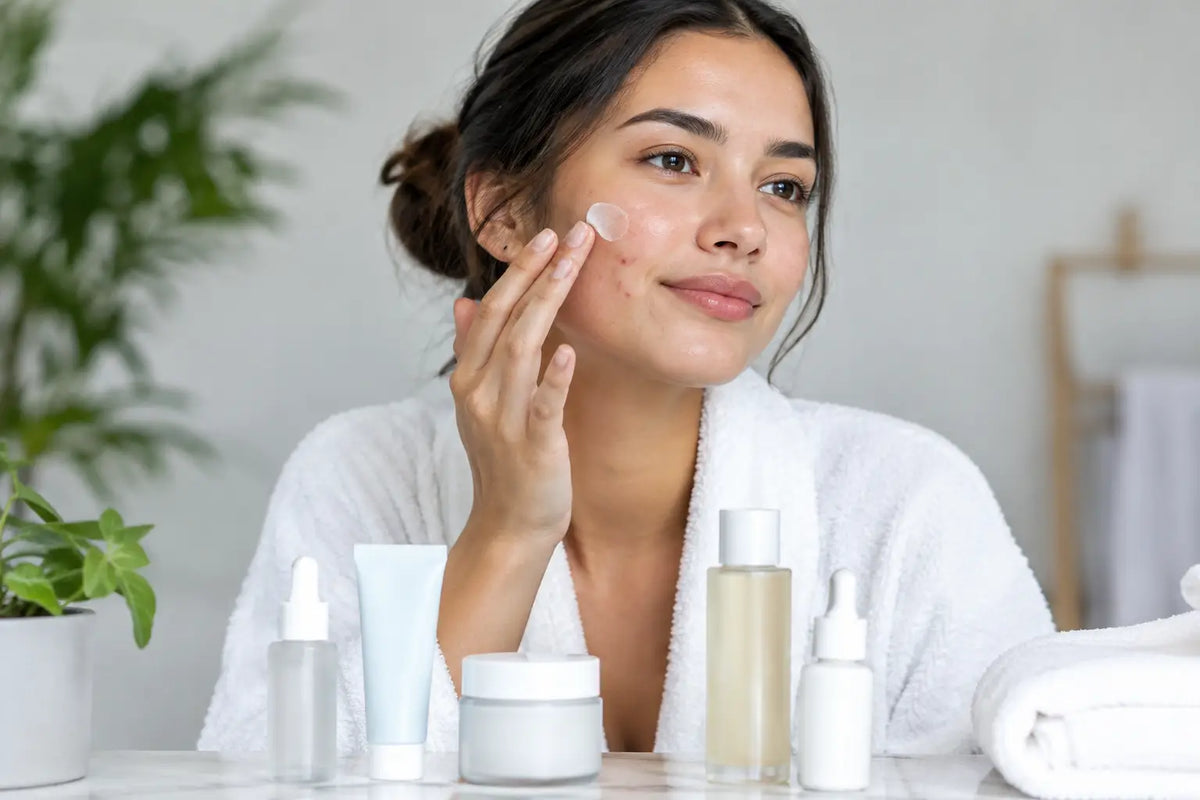
How to layer acne treatments is simpler than the product pileup suggests: put your treatment on clean, dry skin, follow with moisturizer, and avoid using every treatment you own in the same routine. The drawer of half-used bottles usually starts with good intentions, then turns into irritated skin and the feeling that nothing is working.
Acne after thirty can make that feeling sharper. You may be managing clogged pores and chin breakouts while also noticing fine lines or uneven-looking texture. You did not cause this by failing to cleanse correctly or by lacking discipline. Skin can react to hormones, genetics, friction, cosmetics, stress, and more than one factor at once.
The goal is not a longer routine. It is a routine your skin can live with long enough to tell you something useful.
How to layer acne treatments in the right order
The most reliable order is cleanser, acne treatment, moisturizer, then sunscreen in the morning. At night, cleanse, use the treatment you have chosen for that evening, then moisturize.
Apply leave-on acne treatment to skin that is fully dry. Damp skin can make some ingredients feel more irritating, especially if you are also using retinol. A light, even layer is enough. More product does not make a routine more effective, but it can make it harder to tolerate.
Here is the basic framework:
| Routine step | Morning | Evening |
| --- | --- | --- |
| Cleanse | Use a gentle cleanser | Remove sunscreen, makeup, and the day |
| Treatment | Salicylic acid if it suits your routine | Retinol or salicylic acid, depending on the night |
| Moisturize | Use a plain moisturizer | Use a plain moisturizer |
| Protect | Finish with broad-spectrum sunscreen | Not needed |
This order has one exception: a treatment that is meant to be rinsed off follows its own directions. A salicylic acid cleanser, for example, is used during cleansing rather than layered after it. Let the product directions lead when they differ from a general routine.
Can you use retinol and salicylic acid together?
Yes, retinol and salicylic acid can be part of the same overall routine, but using separate products together in the same evening is not automatically the best place to start. Both can be useful for people dealing with clogged pores, breakouts, and texture, yet both can also bring dryness, peeling, or stinging when the routine is too crowded.
Salicylic acid is a beta hydroxy acid that works at the skin surface and inside pores. Under the FDA over-the-counter acne monograph, salicylic acid is recognized at a range of 0.5% to 2% for acne use. Retinol is a vitamin A derivative commonly used in cosmetic skincare and is often chosen for smoother-looking skin and more even-looking texture.
A practical approach is to use salicylic acid in the morning and retinol at night, if your skin is comfortable with both. Another approach is to alternate them on different evenings. Alternating is often the calmer choice if you have had a stripped, tight, or flaky reaction to acne routines before.
Some formulas are formulated with salicylic acid and retinol in one product. That does not mean every separate salicylic acid serum and retinol product should be layered together. The formula, the rest of your routine, and your own history of irritation all matter.
The American Academy of Dermatology includes topical retinoids and salicylic acid among acne treatment options. It also makes clear that acne care is not one-size-fits-all. If you are using a prescription treatment, follow the directions from the clinician who prescribed it before adding other treatments.
Should you use benzoyl peroxide with salicylic acid?
You can, but you may not need both at once. Benzoyl peroxide and salicylic acid address acne in different ways, and some people use both in a routine without trouble. For others, the combination creates a cycle of dryness, redness, and more products applied to compensate.
If benzoyl peroxide is already working for you, keep the rest of the routine spare. Consider using it in one part of the day and salicylic acid in another, rather than layering both leave-on treatments together. Moisturizer is not a reward for irritated skin. It is part of the plan that makes treatment easier to continue.
Avoid adding a scrub, exfoliating brush, or strong peel just because you see congestion. Blackheads and whiteheads are frustrating, but friction and over-exfoliation can leave skin looking angrier while doing little for the clogged pore underneath.
What should you not mix in one acne routine?
The combinations that most often cause trouble are not forbidden pairings. They are too many exfoliating or drying steps piled into one session. Salicylic acid, retinol, benzoyl peroxide, exfoliating acids, scrubs, and astringent toners can each be reasonable in a specific routine. Put several together, and irritation can become the main event.
Pay attention to signals rather than trying to push through them. Persistent burning, swelling, cracking, or a rash means stop the new product and simplify. A plain cleanser, moisturizer, and sunscreen can give you a clearer view of what your skin tolerates. If symptoms are severe or do not settle, seek medical care.
Post-acne marks may also need patience. Acne treatment can help prevent new breakouts from adding to the problem, but over-the-counter treatment cannot diagnose why acne is continuing or address every cause of discoloration and texture.
Does moisturizer make acne worse?
Not necessarily. A moisturizer does not have to feel heavy to be useful, and skipping it can make an acne routine harder to sustain. Look for a formula that feels comfortable, then use enough to reduce tightness after treatment. You do not need a complicated cream with a long list of treatment ingredients.
Sunscreen belongs in the daytime routine because sun exposure can make post-acne marks look more noticeable and can complicate the use of retinol. Choose one you are willing to wear consistently. The best order on paper is not helpful if the finish makes you stop using it.
When should persistent adult acne be evaluated?
See a dermatologist if breakouts are painful, deep, suddenly different from your usual pattern, leaving lasting marks, or taking a real emotional toll. A dermatologist should also evaluate possible cystic or nodular acne. Over-the-counter care has limits, and needing more help is not a sign that you failed at skincare.
For a parent helping a teenager, the same principle applies. Keep the routine simple, avoid stacking treatments because a breakout feels urgent, and ask a doctor about treatment questions involving minors, pregnancy, or breastfeeding.
A calm next step is to choose one acne treatment approach, pair it with moisturizer and daily sunscreen, and give your skin room to respond. For people who want fewer separate steps, XVesuvius® is an FDA over-the-counter acne drug formulated with 2% salicylic acid and ingredients including encapsulated retinol, offered as one twice-daily serum. The right routine is the one that treats acne without turning your bathroom counter into another source of stress.


Share:
Best Acne Routines for Adults Who Want Less
Does Salicylic Acid Dry Skin? What Adults Need