





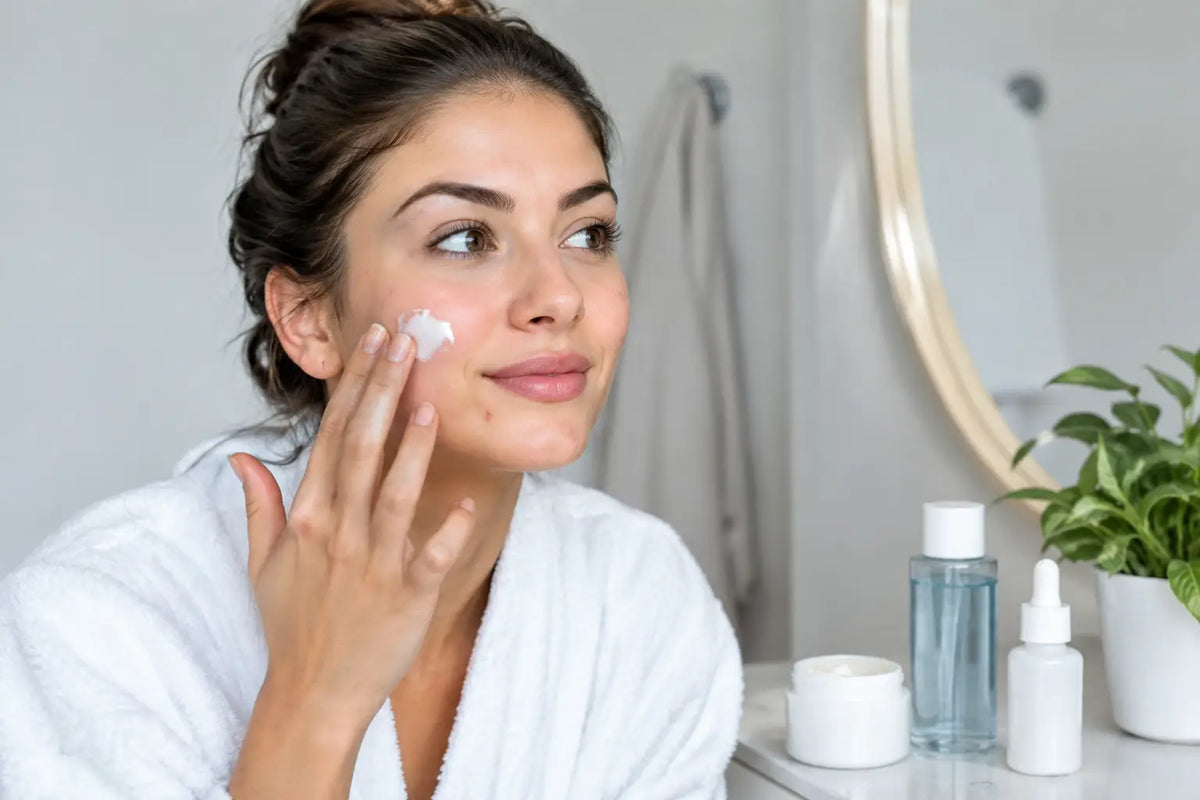
The best acne routines for adults are usually short: use a pore-clearing acne treatment you can tolerate, moisturize when your skin feels dry, and use sun protection for exposed skin. If your bathroom drawer is full of half-used bottles, the problem may not be that you need more products. It may be that each new step has made the whole routine harder to follow.
Adult acne asks for a different kind of routine. You may be dealing with blackheads along your jaw, breakouts around your chin, post-acne marks, and fine lines at the same time. A harsh approach can leave skin looking irritated and uneven. A routine that does too little can leave clogged pores sitting there for weeks.
The goal is not perfection or punishment. It is a routine you can use consistently without turning your face into a daily experiment.
What is the best basic acne routine for adults?
A useful adult acne routine has a clear job for each step: cleanse without over-scrubbing, treat clogged pores with an FDA over-the-counter acne drug or another appropriate acne medicine, add moisture as needed, and protect exposed skin from sun. The American Academy of Dermatology makes a similar practical point in its acne guidance: treatment works better when irritation and product overload are kept in check.
| Step | What it should do | What can make acne routines harder |
|---|---|---|
| Gentle cleansing | Remove makeup, oil, and daily buildup | Scrubbing, harsh cloths, or cleansers that leave skin tight |
| Acne treatment | Address breakouts and clogged pores | Layering several acne medicines without a plan |
| Moisturizer | Make dryness and flaking less distracting | Heavy products that seem to leave pores more congested |
| Sun protection | Limit the look of darkening in post-acne marks | Skipping it because a product feels cosmetically unpleasant |
You do not need every category in every possible form. Some people prefer a separate cleanser, treatment, and moisturizer. Others want one treatment serum that reduces the number of decisions. Both can make sense if the formula and use instructions fit your skin.
Why do adult acne routines need to be simpler?
Because irritation can look a lot like failure. Skin that is dry, stinging, flaky, or visibly red can make you feel compelled to add another product or switch everything at once. Then it becomes impossible to know what is helping and what is making breakouts look worse.
Adult skin can be acne-prone and dry at once. This is especially common for people who have used strong cleansers, spot treatments, masks, and exfoliants for years. Acne is not evidence that you are dirty, undisciplined, or using the wrong towel. Pores can clog for reasons that have little to do with effort.
The better move is usually to stop stacking similar treatments. If you introduce an acne medicine, keep the surrounding routine plain for a while. Use a gentle cleanser. Use moisturizer if your skin needs it. Let the treatment be the treatment.
Can you use retinol and salicylic acid together?
Yes, retinol and salicylic acid can be used together, but the right approach depends on the formula, how often it is used, and how your skin responds. The difficult part is not whether the ingredients can appear in the same routine. It is avoiding a routine that leaves you so uncomfortable that you stop using it.
Salicylic acid is an FDA-recognized over-the-counter acne drug ingredient in the FDA monograph range of 0.5% to 2%. It helps clear clogged pores, which is why it is often useful for blackheads, whiteheads, and small breakouts. Retinol is a cosmetic ingredient often used for smoother-looking texture and a more even-looking complexion.
A well-formulated product can make the pairing simpler than using separate layers, especially if you tend to overapply or lose track of which product goes on when. Still, more is not automatically better. If your skin becomes persistently irritated, simplify the rest of the routine and consider whether the product or frequency is right for you.
Do not add an exfoliating scrub, strong peel, and several treatment layers simply because your skin has a few active breakouts. That approach often creates more discomfort without making the routine more thoughtful.
How should you start an adult acne treatment routine?
Follow the product directions exactly, and change one meaningful thing at a time. This is less exciting than rebuilding your shelf, but it gives you a fair read on what your skin can handle.
Use only a small amount of treatment product where directed. Avoid aggressive rubbing. If you use makeup, remove it gently rather than treating cleansing as another exfoliation step. If your skin feels dry, a simple moisturizer can make a consistent acne routine easier to live with.
The FDA advises users of over-the-counter topical acne products to pay attention to severe reactions, including significant swelling, trouble breathing, or faintness, and seek immediate medical help if they occur. Mild dryness can happen with acne treatments, but severe or worsening irritation is a reason to stop and speak with a clinician.
What should adults avoid in an acne routine?
The biggest trap is treating every breakout as an emergency. A new pimple can trigger a mask, a scrub, a spot treatment, a new serum, and a diet overhaul by bedtime. It is understandable. It is also hard on your skin and hard to evaluate.
Avoid picking and squeezing whenever possible. It can make a breakout look more inflamed and may leave a post-acne mark that stays visible longer than the pimple itself. Avoid using products that sting just because you assume that sensation means they are working.
Be skeptical of routines built around endless rotation. A product can be pleasant and still not be necessary. The routine earns its place by doing a specific job without creating a new problem.
When should you see a dermatologist for adult acne?
See a dermatologist if you have deep, painful bumps, cysts, nodules, widespread breakouts, or marks that are changing the way you feel about leaving the house. A dermatologist can assess whether prescription treatment or another medical approach is appropriate. Over-the-counter options have limits, and pretending otherwise wastes time.
It also makes sense to seek care if breakouts began suddenly, if they seem connected to a medication change, or if an otherwise simple routine has not helped. Adult acne can have patterns that deserve an individual assessment.
For a parent choosing an over-the-counter acne treatment for a teenager, keep the routine gentle and follow the label. Ask a doctor about use for a child, pregnancy, breastfeeding, significant irritation, or any concern that feels bigger than a few ordinary breakouts. A teenager does not need a crowded routine or a lecture about hygiene.
Is one acne treatment step enough?
For some people, yes. A single treatment step can be enough when it addresses clogged pores and fits comfortably into morning and evening use. For others, a dermatologist may recommend a more tailored plan. The honest answer depends on the kind of acne, the products already in use, and how much irritation is getting in the way.
If fewer products would make your routine easier to keep, XVesuvius® is an FDA over-the-counter acne drug formulated with 2% salicylic acid, plus ingredients including encapsulated retinol, peptides, honey, ferments, and botanical extracts. It is one option for people who want a single twice-daily step for breakouts, clogged pores, and skin that looks smoother and more even.
Start with the routine you can actually repeat: one clear treatment plan, less friction, and enough patience to see what your skin is telling you.


Share:
Salicylic Acid Versus Benzoyl Peroxide for Acne
How to Layer Acne Treatments Without Irritation