





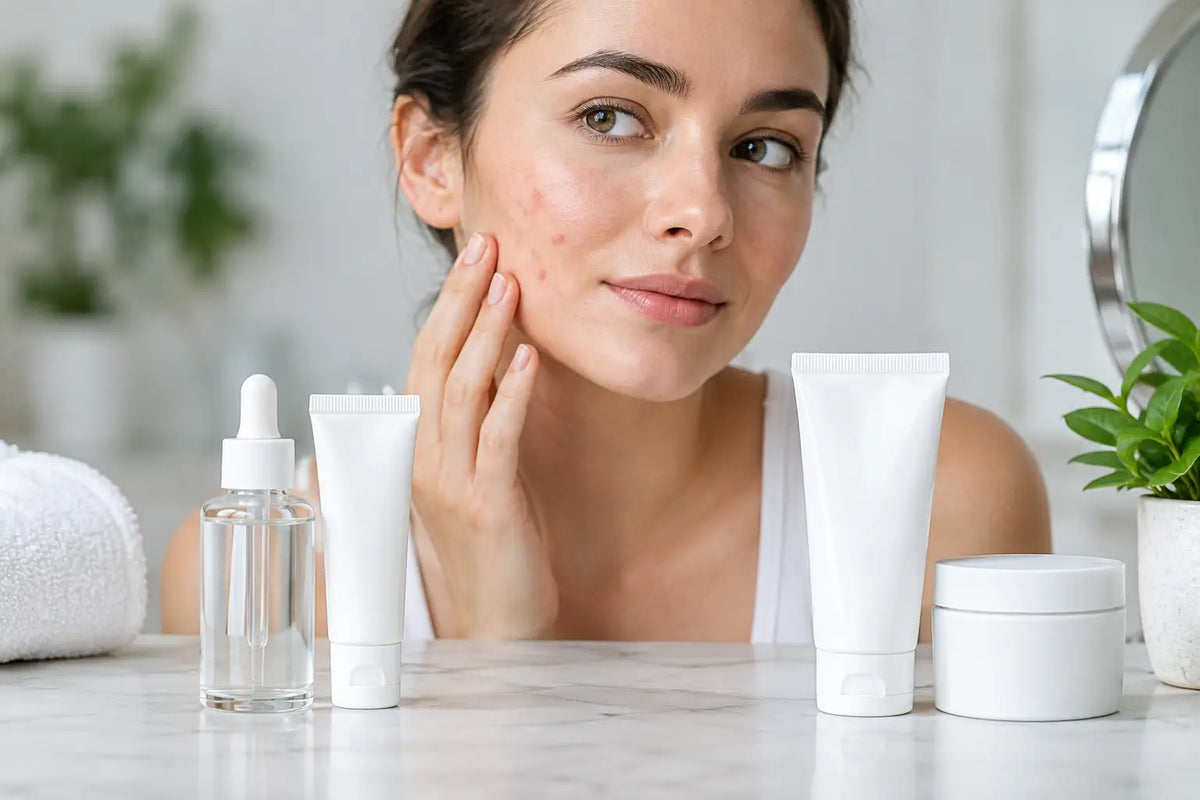
Salicylic acid versus benzoyl peroxide is not really a question of which ingredient is best. Salicylic acid usually makes more sense for clogged pores, blackheads, and rough-looking texture, while benzoyl peroxide is often used for red, inflamed pimples. If you are breaking out in adulthood while also trying not to turn your face into a dry, irritated experiment, the distinction matters.
Neither ingredient means you caused your acne by missing a cleansing step or eating the wrong lunch. Acne is complicated, and adult skin has its own frustrations: a chin breakout that arrives beside fine lines, makeup that suddenly sits differently, and a drawer full of products that asked for patience but gave you peeling instead.
What is the difference between salicylic acid and benzoyl peroxide?
The main difference is where each ingredient tends to focus. Salicylic acid is oil-soluble, meaning it can work within the pore environment where oil and dead skin cells can collect. Benzoyl peroxide is more often chosen for inflammatory breakouts, such as red pimples that feel sore or seem to appear all at once.
Here is the practical comparison.
| Concern | Salicylic acid | Benzoyl peroxide |
|---|---|---|
| Clogged pores and blackheads | Often a strong fit | May be less targeted for this concern |
| Whiteheads and uneven-looking texture | Can help keep pore congestion in check | May be useful if lesions are inflamed |
| Red, inflamed pimples | May help if clogged pores are part of the pattern | Often a common choice |
| Dryness and visible flaking | Can occur, especially with overuse | Can occur and may feel more drying for some people |
| Fabric contact | No bleaching concern | Can bleach towels, pillowcases, and clothing |
Both are recognized options in acne care. The American Academy of Dermatology includes salicylic acid and benzoyl peroxide among topical ingredients used for acne, but they are not interchangeable. The better choice depends on what your skin is doing most often, not on which product has the loudest promise.
Is salicylic acid better for blackheads and clogged pores?
Usually, yes. Blackheads and many whiteheads begin with a pore that is blocked by a mix of oil and shed skin cells. Salicylic acid helps loosen that buildup, which is why it is so often part of a routine for congested skin, visible pores, and bumps that are not always red.
The FDA over-the-counter acne monograph allows salicylic acid in a range of 0.5% to 2%. A formula with 2% salicylic acid is at the upper end of that allowed range. More is not automatically better, particularly if your skin is already dry, stinging, or visibly flaky.
Salicylic acid can also make sense for the person whose acne looks less like dramatic pimples and more like a constant cycle of clogged pores. This is common in adult acne, especially around the chin, jawline, and lower face. A topical routine cannot tell you why that pattern is happening, but it can be a reasonable part of managing what is visible on the skin.
Is benzoyl peroxide better for inflamed pimples?
Benzoyl peroxide is often used when breakouts are red and inflamed. It has a long history in over-the-counter acne care, and the American Academy of Dermatology has included it in acne treatment guidance.
The trade-off is that benzoyl peroxide can be difficult to live with for some people. It may cause dryness, irritation, or peeling, and it can bleach fabric. That does not make it a bad ingredient. It means the right routine has to account for how your skin tolerates it and how much else you are already using.
If your face feels tight after cleansing, makeup catches on dry patches, or you are cycling between treating a pimple and soothing the irritation left behind, adding more treatment may not be the answer. The goal is not to create a harsher routine. It is to choose a routine you can actually keep using as directed.
Can you use salicylic acid and benzoyl peroxide together?
You can, but using both at the same time can be too much for some skin. The risk is not that the ingredients are inherently incompatible. The concern is cumulative irritation, especially if you also use retinol, exfoliating acids, scrubs, or drying cleansers.
A simpler approach is often easier to judge. Start with the ingredient that matches your main concern, then pay attention to visible dryness, burning, or persistent peeling. If those show up, reduce frequency or simplify the rest of the routine rather than pushing through discomfort.
This is where a lot of acne routines go wrong. Someone sees a new pimple and adds another product. Then another. Soon, it is impossible to know whether the breakouts are continuing because of acne, irritation, or both. More steps can feel productive. They are not always useful.
Should you choose salicylic acid if you also use retinol?
It depends on the formula and your skin's response. Retinol is often used for smoother-looking skin and a more even-looking appearance, while salicylic acid is used for acne and clogged pores. They can be part of the same overall routine, but introducing several new products at once makes irritation much more likely and makes it hard to identify the cause.
For adults dealing with acne and visible signs of skin aging, the appeal of a streamlined formula is obvious. You should not have to choose between addressing breakouts and having a routine that respects the fact that your skin is not the same as it was in high school.
A formula can be made with salicylic acid alongside cosmetic ingredients such as retinol, peptides, honey, ferments, and botanical extracts. Those ingredients may support a smoother, more even-looking complexion, but they do not change what an over-the-counter acne treatment can realistically do. It will not treat deep, painful nodules, cystic acne, or a condition such as rosacea or eczema. Those concerns deserve evaluation from a dermatologist.
How do you choose between salicylic acid and benzoyl peroxide?
Choose based on the pattern, not the occasional worst breakout. If blackheads, whiteheads, and clogged pores are the problem you see week after week, salicylic acid is often the more natural starting point. If red, inflamed pimples are the dominant issue, benzoyl peroxide may be the ingredient you want to discuss with a dermatologist or consider within a simple over-the-counter routine.
For a parent helping a teen, the same principle applies: keep the routine simple and watch for irritation. Ask a doctor before using acne treatment for a child, or if there are deep painful bumps, widespread breakouts, significant distress, or signs that over-the-counter care is not enough.
Read the Drug Facts label, follow its directions, and give your skin enough consistency to show you what it can tolerate. If you are pregnant or breastfeeding, ask a doctor before choosing an acne treatment.
For readers whose main issue is recurring clogged pores alongside a desire for smoother, more even-looking skin, XVesuvius® is one option. It is an FDA over-the-counter acne drug formulated with 2% salicylic acid and cosmetic ingredients including encapsulated retinol and peptides, designed for people who prefer a single twice-daily step over a crowded routine.
The calm next step is simple: choose the ingredient that fits the breakouts you have most often, then keep the rest of your routine quiet enough to tell whether it is helping.


Share:
Salicylic Acid Guide for Adult Acne and Texture
Best Acne Routines for Adults Who Want Less