





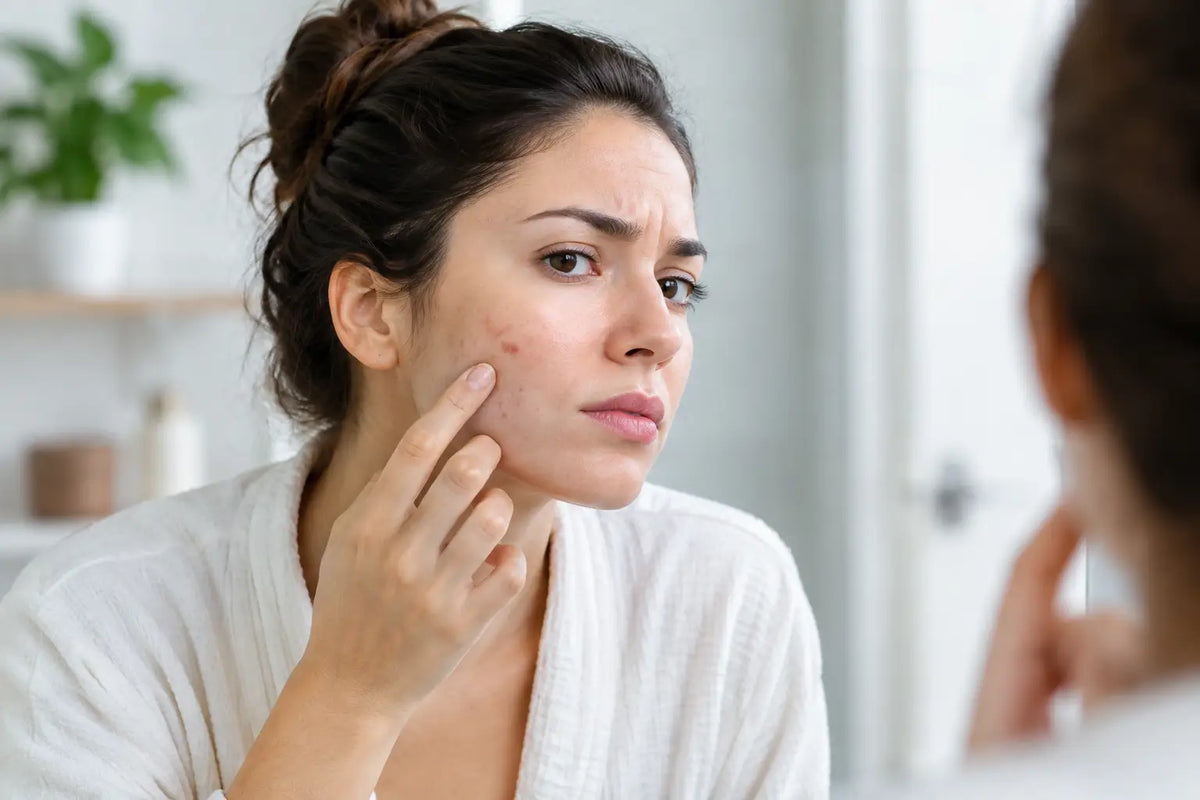
Adult breakouts can keep showing up long after the years when people expect acne to be over. They often look less like a full-face flare and more like a repeating pattern: a cluster along the jaw, congestion around the mouth, a blemish that appears just as the last mark begins to fade. It is frustrating partly because the usual advice can feel built for someone else.
For adults, the goal is not to punish the skin into behaving. It is to use an acne routine that addresses clogged pores and visible blemishes while remaining tolerable enough to use consistently. That matters when skin is also dealing with dryness, uneven-looking texture, or the appearance of fine lines.
What Causes Adult Breakouts?
A breakout starts when a pore becomes congested with oil and shed skin cells. Once that process is underway, a visible blemish can form. The basic mechanism is familiar, but the reasons congestion keeps recurring vary from person to person.
For some adults, the pattern tracks with normal shifts in the body over the month. For others, it appears around areas exposed to hair products, makeup, sunscreen, shaving, sweat, or the friction of a phone, helmet, or face covering. Stress and sleep changes can coincide with breakouts, too. None of this means a person caused their acne or failed at skincare. Skin can be difficult even when a routine is careful and consistent.
There is also a practical issue: many adult routines contain too much. A cleanser for blemishes, a separate exfoliant, a treatment serum, a retinoid, a spot treatment, and a moisturizer may all make sense individually. Used together, they can leave skin feeling tight, stingy, flaky, or unpredictable. Then the routine gets paused, restarted, and changed again. The drawer of half-used bottles grows.
Adult skin has competing needs
A teenager may be primarily concerned with active blemishes and shine. An adult may be managing those concerns alongside visible post-blemish marks, rough-looking texture, or fine lines. This is why a harsh, all-or-nothing approach often feels like a poor fit.
More intensity is not always more useful. If a product makes regular use difficult, the intended treatment plan can become intermittent. The better routine is usually the one that fits into ordinary mornings and evenings without turning every application into a negotiation with your skin.
A Simpler Routine for Adult Breakouts
A useful acne routine has a clear job for each step. Start with gentle cleansing, use an appropriate over-the-counter acne treatment as directed, and add a moisturizer if skin feels dry. Sunscreen is also useful during the day, particularly when treating blemishes or addressing the appearance of lingering marks.
The temptation is to add a new product every time a blemish appears. Often, this makes it harder to tell what is helping and what is irritating. Give a routine room to be consistent before layering on another exfoliant, mask, scrub, or spot treatment.
Salicylic acid is a common over-the-counter acne treatment ingredient because it helps exfoliate within congested pores. It can be a practical choice for recurring blackheads, whiteheads, and small visible blemishes. It cannot answer every skin concern, and it may not be appropriate as the only step for every person. Still, it has a defined role in a routine built around keeping pores from becoming repeatedly congested.
XVesuvius is an FDA over-the-counter acne drug formulated with salicylic acid as its single drug active ingredient. Its Dermacetyl complex also contains encapsulated retinol, peptides, honey, ferments, and botanical extracts. The product is designed as one twice-daily treatment rather than another piece of a long, fragmented routine.
That does not mean every adult needs the same formula or should use every product in the same way. Skin that feels irritated, especially after recent use of multiple exfoliating products, may benefit from simplifying first. Follow the Drug Facts directions, avoid stacking treatments casually, and pay attention to how your skin feels from day to day.
What to Avoid When Skin Is Already Irritated
Irritation can look deceptively similar to a worsening acne problem. Skin may feel hot, tight, itchy, or sore. It may develop visible flaking or look redder than usual. Adding more treatment in response can create a cycle where it becomes difficult to separate new blemishes from a reaction to the routine itself.
Avoid treating every spot as an emergency. Picking, squeezing, and repeatedly applying strong products to one small area can leave behind a more noticeable mark. It is understandable to want a blemish gone quickly. But skin usually responds better to measured, consistent care than constant escalation.
Be cautious with combinations. Using several products that exfoliate or affect skin turnover can be too much for some people, especially at the start. If you use prescription treatment, ask the prescribing clinician or pharmacist how it fits with over-the-counter acne products. The right answer depends on the medication, your skin history, and the rest of your routine.
When Adult Breakouts Need Medical Attention
Over-the-counter care has limits. Consider seeing a dermatologist or another qualified clinician if breakouts are painful, leave noticeable scars, spread quickly, or have not improved despite steady use of an appropriate routine. Medical care is also appropriate when a skin change is unusual, severe, or difficult to identify.
For a parent shopping for a young person, it is reasonable to ask whether a routine is too harsh and when a clinician should be involved. A simple approach is often easier for a family to follow than a counter full of products. If a teenager has painful lesions, visible scarring, significant distress, or persistent breakouts that are not responding to over-the-counter care, a medical evaluation can help clarify the next step.
A clinician may also be useful when acne overlaps with other concerns, such as persistent irritation or a rash that does not behave like ordinary blemishes. Do not assume every bump needs more acne treatment.
The Goal Is a Routine You Can Live With
Adult breakouts are not a sign that you missed some basic skincare rule. They are a recurring skin concern that may need a more deliberate approach than the spot treatments of adolescence. The useful question is not, “What is the strongest thing I can put on this?” It is, “What routine can I use steadily without making my skin feel worse?”
Start there. Keep the routine clear, make changes one at a time, and seek medical guidance when the pattern calls for more than over-the-counter care. Consistency is less dramatic than a shelf full of promises, but it gives your skin a fair chance to settle into a routine that makes sense.


Share:
Treating Teenage Breakouts With a Steady Routine
Adult Breakout Management That Fits Real Life