





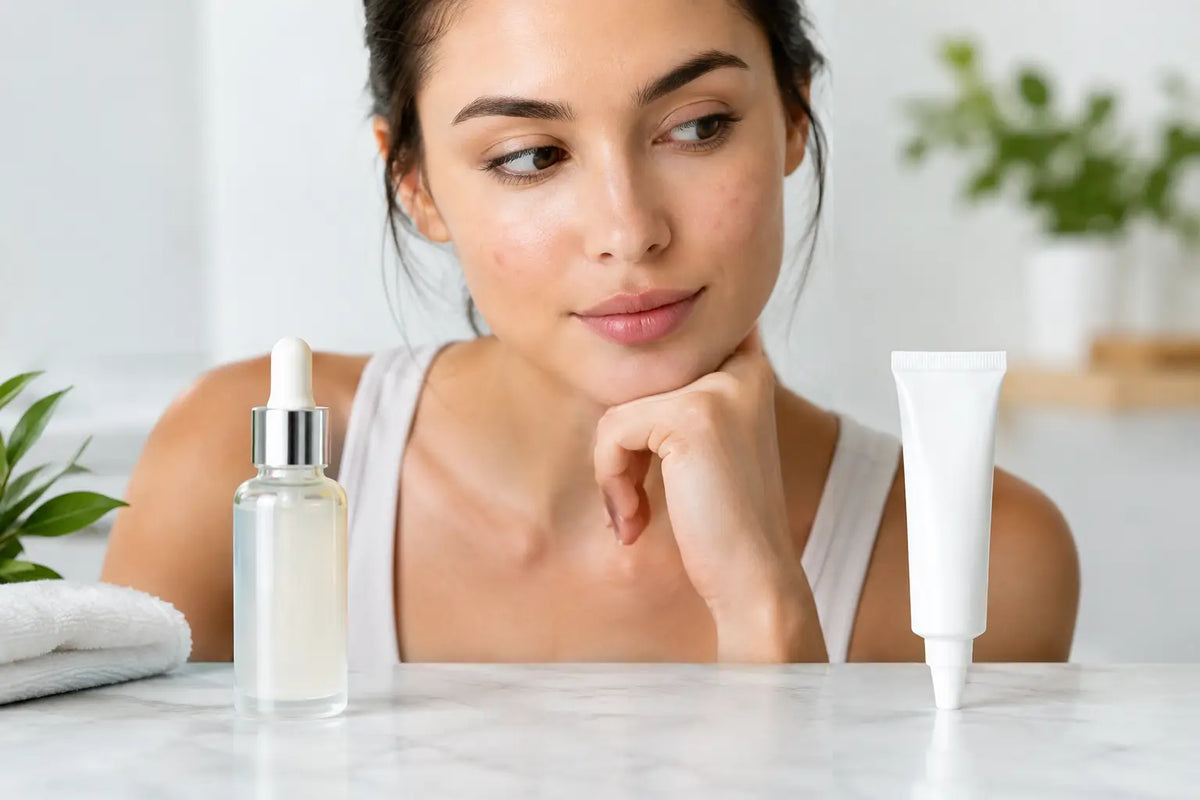
Choose an acne serum for recurring, spread-out breakouts and clogged pores; reserve a spot treatment for the occasional individual pimple. The acne serum versus spot treatment question gets harder when you have a drawer of half-used bottles and skin that is still breaking out while starting to look less even.
A spot treatment can be useful. It is not automatically the better treatment just because it feels more targeted. If breakouts tend to return in the same areas, treating only the blemishes you can see may leave the rest of the pattern untouched.
Acne serum versus spot treatment: what is the real difference?
The difference is less about the texture in the bottle than the job it is meant to do. A spot treatment is applied to a visible blemish. An acne serum is generally applied in a thin layer over the areas where acne tends to occur, such as the chin, jawline, forehead, or cheeks.
That distinction matters because acne begins before every clogged pore becomes obvious. Blackheads, whiteheads, and small bumps can be forming beneath the surface before there is anything dramatic to dab with a spot treatment. A leave-on serum used across a breakout-prone area is meant to address that broader tendency.
| | Acne serum | Spot treatment |
|---|---|---|
| Best fit | Recurring breakouts and clogged pores across an area | An occasional visible blemish |
| Where it goes | A thin layer over acne-prone skin | Directly on the blemish |
| Routine role | Ongoing treatment step | As-needed support |
| Common drawback | Can irritate if the formula or frequency is not a fit | May not address nearby clogged pores |
Neither category is automatically gentle or harsh. The formula, the amount used, and the rest of the routine matter more than the word on the label.
When does a spot treatment make sense?
A spot treatment makes sense when your skin is generally settled and a blemish shows up now and then. It can also be a practical option for someone who knows that applying a treatment over a larger area will be more than their skin tolerates.
Many spot treatments use ingredients such as benzoyl peroxide, sulfur, or salicylic acid. They can dry down a pimple, but dryness is not the same thing as a better outcome. If the skin around the blemish becomes tight, flaky, or stinging, it can be tempting to add more products in response. That is how a small problem becomes an exhausting routine.
Use a spot treatment with a light hand. Put it where the blemish is, not across unaffected skin out of frustration. If you are already using an acne serum, adding a strong spot treatment to the same area can be more irritating than helpful.
Why can an acne serum be better for recurring breakouts?
An acne serum can make more sense when you recognize a familiar map of breakouts: the chin that keeps clogging, the forehead with persistent texture, or the jawline that never seems fully clear. In those cases, waiting for each pimple to appear means reacting late, again and again.
Salicylic acid is especially relevant for blackheads, whiteheads, and clogged pores because it helps loosen the material that collects in pores. The FDA's over-the-counter acne monograph recognizes salicylic acid in a range from 0.5% to 2% for acne treatment. The American Academy of Dermatology also includes salicylic acid among over-the-counter options for acne.
A serum is not a promise that every breakout will disappear. Acne can be influenced by factors that topical care cannot settle on its own, and some formulas simply will not suit every person. But a well-chosen leave-on product can be a more coherent approach than treating each new spot as a separate emergency.
Can you use an acne serum and a spot treatment together?
Yes, sometimes, but only if your skin stays comfortable. Start by deciding which product is doing the main job. If you have ongoing clogged pores and breakouts across an area, let the serum be the consistent step and use a spot treatment sparingly for an especially noticeable blemish.
Pay attention to your skin rather than trying to force a complicated schedule. Stinging that continues, visible peeling, or a tight, shiny feeling are signs to simplify. More treatment is not always more useful, particularly for adults who are also trying to keep their skin looking smooth and even.
This is also where many routines become unnecessarily crowded. An exfoliating toner, an acne serum, a spot treatment, and a retinol product may all sound reasonable in isolation. Together, they may be too much. If a formula contains retinol as an ingredient, introduce it thoughtfully and avoid piling on other exfoliating steps without a clear reason.
What should an adult acne routine focus on?
For recurring acne, focus on a treatment you can use consistently, a mild cleanser, and sunscreen during the day. Consistency is not glamorous, but it is more useful than rotating through products every time a blemish appears.
Adult acne is not evidence that you failed at hygiene or discipline. Many people have already tried drying cleansers and aggressive spot treatments before realizing their skin needs a more measured plan. The goal is not to make your face feel stripped. It is to use an appropriate treatment while keeping the routine manageable enough to continue.
If you are a parent shopping for a teenager, the same principle applies: a pile of harsh products is not automatically a better plan. Ask a doctor about the right approach for your child, especially if breakouts are painful, widespread, leaving lasting changes in the skin, or causing significant distress.
When is an over-the-counter acne treatment not enough?
See a dermatologist if breakouts are deep and painful, if they are leaving marks that concern you, or if an over-the-counter routine has not been enough. A dermatologist can help sort out whether acne needs prescription care and can account for the irritation caused by past treatments.
This is not a failure of your routine. Over-the-counter care has a defined role, and persistent acne sometimes needs more than a topical product from the shelf. A clear limit is useful information, not a reason to keep buying more bottles.
For someone who wants to replace a scattered routine with a single twice-daily step, XVesuvius® is an FDA over-the-counter acne drug formulated with 2% salicylic acid, plus encapsulated retinol, peptides, honey, ferments, and botanical extracts. It is one option for recurring breakouts and clogged pores when smoother, more even-looking skin matters too. Choose the approach you can use calmly and consistently, then give your skin room to tell you whether it is working.


Share:
Blackhead Treatment Guide for Clearer Pores