





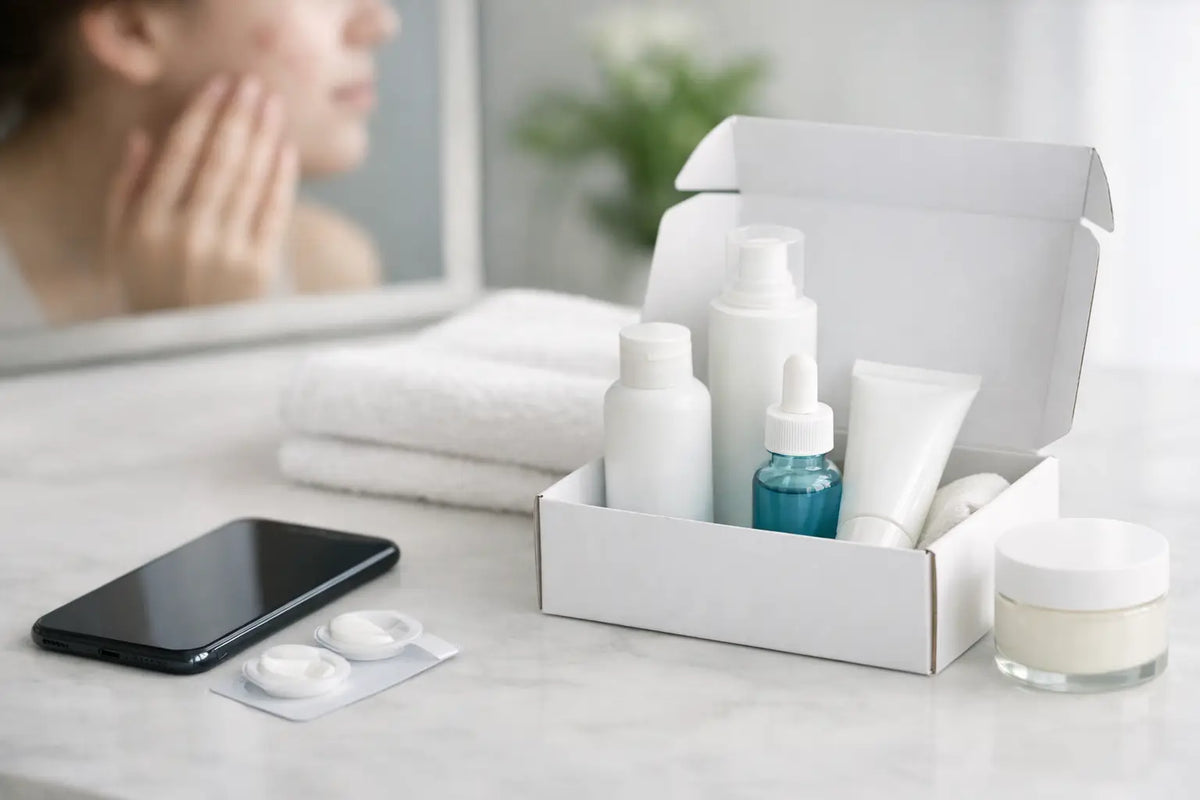
An acne treatment subscription is worth considering when it helps you keep using a treatment that fits your skin and replaces the drawer of half-used bottles. It is not worth it merely because it is convenient. Acne care is repetitive by nature, and the product that works best on paper is of little use if your face feels tight, stinging, or visibly irritated every time you apply it.
For adults managing recurring breakouts alongside uneven-looking texture or the visible marks left by past blemishes, a subscription can remove one practical obstacle: running out and improvising with whatever is nearby. For a parent buying treatment for a teenager, it can also make a consistent routine easier to oversee. The meaningful question is whether the formula, directions, and refill plan make regular use more realistic.
What an acne treatment subscription should simplify
A crowded acne routine often grows one purchase at a time. There is a cleanser for congestion, a spot treatment for active blemishes, a treatment serum, an exfoliant used cautiously, and a moisturizer added because the rest of the routine feels uncomfortable. None of this means a person has done anything wrong. It means acne products are commonly sold as separate answers to a problem that tends to show up in several ways at once.
A useful acne treatment subscription should simplify that pattern, not add another item to it. It should have a clear role in the routine and directions that are practical enough to follow when life is busy. If the subscription requires a complicated sequence of additional products to make sense, it may not be reducing the work at all.
Consistency matters because acne treatment is generally judged over continued use, not by what happens after a single application. Skin can also have changing needs. A routine that feels comfortable during one season may need adjustment when indoor heat, travel, stress, shaving, makeup, or a new prescription changes how the skin feels.
Look at the treatment before the subscription
Start with the Drug Facts label and the actual treatment claim. An over-the-counter treatment should state its intended use, directions, warnings, and its drug active clearly. This is more useful than a long ingredient list built to sound impressive.
Salicylic acid is a familiar choice for acne because it helps clear pores. It can be a sensible option for recurring clogged pores and breakouts, but no over-the-counter product can answer every cause of a changing skin pattern. It also cannot promise that every visible post-blemish mark or uneven area will disappear. Those concerns often take patience, and their appearance can be influenced by sun exposure, irritation, and picking.
Skin tolerance belongs in this assessment. Some people can use a salicylic acid treatment as directed with little disruption. Others notice dryness, peeling, or sensitivity and may need to reassess their routine with a healthcare professional. More treatment is not automatically better. The goal is to use the product as directed in a way that skin can live with.
XVolcano's XVesuvius(R) is an FDA over-the-counter acne drug formulated as a single twice-daily product. Its single drug active is salicylic acid. The proprietary Dermacetyl(R) complex also contains clinically studied ingredients, including encapsulated retinol, peptides, honey, ferments, and botanical extracts. Those ingredients are not drug actives. Their presence does not change the directions or warnings on the Drug Facts label.
That distinction matters. A person shopping for fewer steps deserves to know what treats acne under the label and what is included for other formulation purposes. Clear language is part of making a good decision.
A simpler routine still needs room for judgment
A subscription should not pressure someone to keep applying a product when their skin is signaling a problem. Follow the label. If excessive dryness, persistent irritation, swelling, or another concerning reaction occurs, stop use and seek advice from a healthcare professional.
For parents, this is especially relevant. Acne is common during adolescence, but a young person should not be expected to manage a reaction alone. Read the label together, keep the routine straightforward, and make space for them to say if their skin feels uncomfortable. If breakouts are painful, widespread, leaving noticeable scars, or affecting confidence and daily life, professional evaluation may be appropriate.
The subscription questions that actually matter
Convenience is real, but subscriptions can also be easy to forget once a card is on file. Before enrolling, check whether the company makes it clear how to manage future shipments, pause, or cancel. A reasonable subscription should not make a person work to regain control of an order.
It also helps to consider how much product is actually being used. A face treatment used twice daily will be finished differently depending on the application area and the amount applied. Do not compensate for running low by using more than directed. If the supply schedule does not match real use, convenience turns into waste or gaps in treatment.
Ask a few practical questions:
- Is this the main acne treatment in the routine, or another layer on top of several others?
- Can the product be used as directed without leaving skin persistently uncomfortable?
- Are the refill, pause, and cancellation terms easy to find and understand?
- Does the company explain its Drug Facts label and safety information plainly?
Avoid stacking treatments without a plan
The urge to combine products is understandable, especially after a new breakout appears. But stacking several acne-focused products can make it difficult to tell what is helping and what is causing dryness or irritation. A face that feels raw or constantly tight may be harder to care for consistently.
If you already use a prescription treatment, have a history of sensitivity, or are considering a product containing retinol during pregnancy or while nursing, ask a healthcare professional how to organize your routine. This is not a reason to abandon treatment. It is a reason to make choices with the full picture in view.
The same applies to adults who are addressing both breakouts and early visible signs of aging. You do not need to choose between treating acne and caring about how texture, fine lines, or uneven tone look. But a routine works better when each product has a defined purpose and the skin is not being asked to tolerate every ingredient at once.
When a subscription is not the right answer
A subscription is not a substitute for medical care. If a breakout pattern has changed suddenly, is painful, is leaving scars, or is accompanied by a reaction that concerns you, a healthcare professional can help determine the next step. An over-the-counter acne treatment has a specific labeled role, and it should be used within that role.
It may also be sensible to wait before subscribing if you have not yet learned how a formula feels on your skin. A recurring order makes more sense after you understand the directions, can use the product comfortably as directed, and know it can replace rather than multiply your routine.
There is no prize for owning the most products. The better routine is the one that gives treatment a clear place, leaves skin feeling manageable through regular use, and does not turn every new blemish into another purchase.


Share:
A Simple Acne Routine You Can Keep Using
How to Treat Clogged Pores Without Overdoing It